Guides · Fittings
Best isolation valves UK: full-bore, service and push-fit options
A UK isolation-valve buying guide comparing quarter-turn service valves, full-bore Ballofix designs, push-fit bodies and screw-down valves by access, bore and connection.
Affiliate links: We earn from some links to Wickes through the Awin network. You do not pay more. How this works.
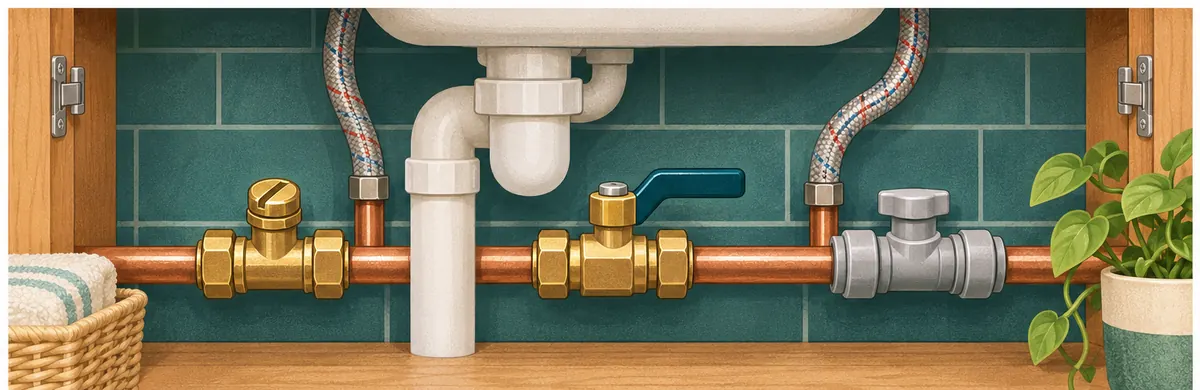
For a tap, toilet or appliance, a compact quarter-turn valve is normally the useful choice. For a longer distribution run, bore size and handle access matter more. The “best” valve is therefore a match between the job, the pipe and the space—not simply the heaviest brass body.
This shortlist is based on published specifications. We have not tested the valves. For how to turn one, deal with a seized slot and decide when to use the stopcock, see how isolation valves work.
What to buy for each job
| Option | Connection and operation | Published point worth checking | Sensible use |
|---|---|---|---|
| Pegler Ballofix 3381ZA | 15mm compression, screwdriver-operated quarter turn, DZR brass, chrome finish | Pegler's catalogue identifies a straight-pattern isolating ball valve | A durable, compact compression valve where a screwdriver slot is acceptable |
| Primaflow isolating valve | 15mm compression, screwdriver quarter turn | Wickes states brass, 4 bar operating pressure and WRAS approval number 0912330 | A visible local valve for a domestic tap or appliance, if 4 bar suits the system |
| JG Speedfit 15SVP | 15mm push-fit, screwdriver quarter turn | Wickes states copper, Speedfit PEX and polybutylene compatibility; inserts required for plastic | A flame-free, demountable connection in a tight space |
| Full-bore lever ball valve | Compression or push-fit, lever quarter turn | Bore and pressure rating vary by product | A run where easy operation and low restriction matter |
| Screw-down stop or service valve | Multi-turn spindle | Flow direction and washer condition matter | An existing like-for-like arrangement, not the default compact tap valve |
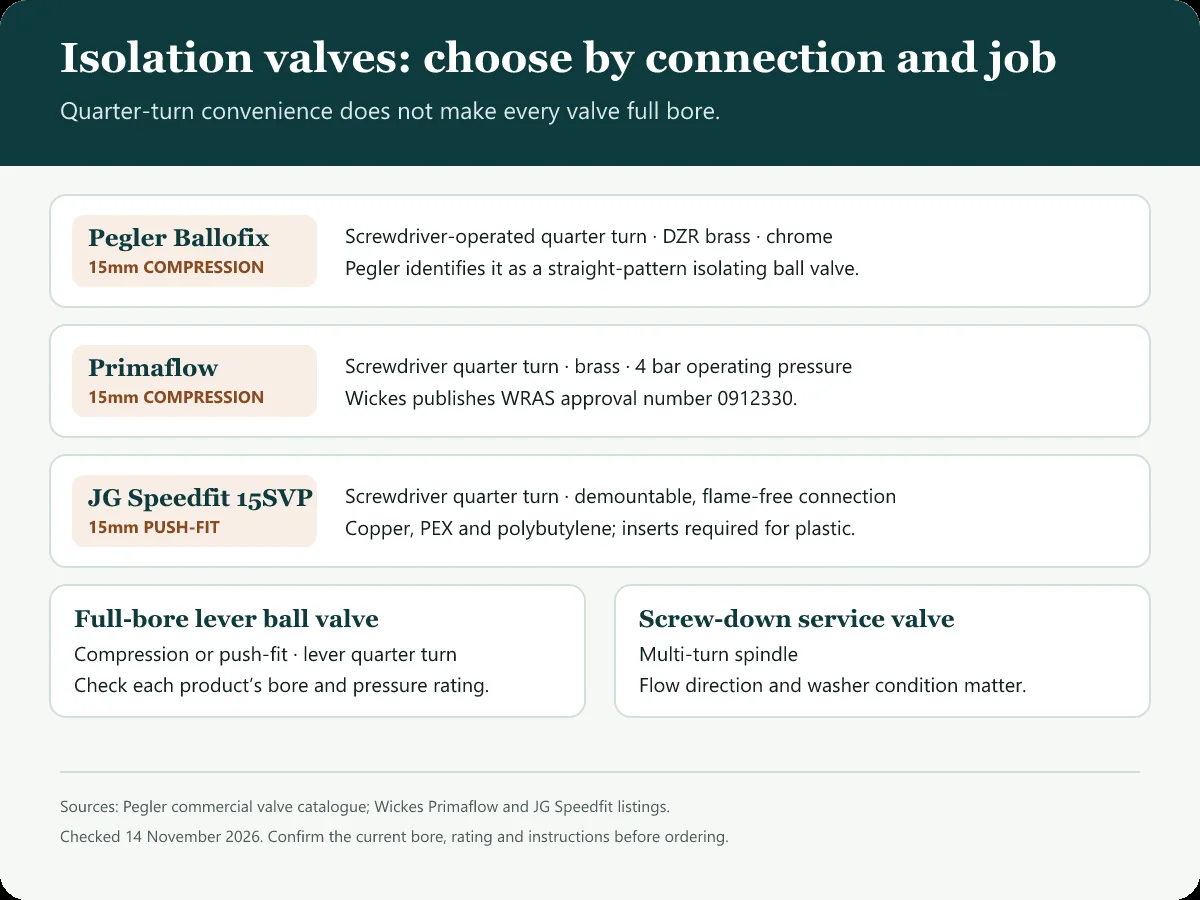
Embed this infographic
<figure>
  <a href="https://leatmere.co.uk/guides/best-isolation-valves-uk/"><img src="https://leatmere.co.uk/assets/images/best-isolation-valves-uk-infographic.webp" alt="Comparison infographic showing connection, operation and published details for five isolation valve types"></a>
  <figcaption>Infographic: Best isolation valves UK from <a href="https://leatmere.co.uk/guides/best-isolation-valves-uk/">Leatmere</a>.</figcaption>
</figure>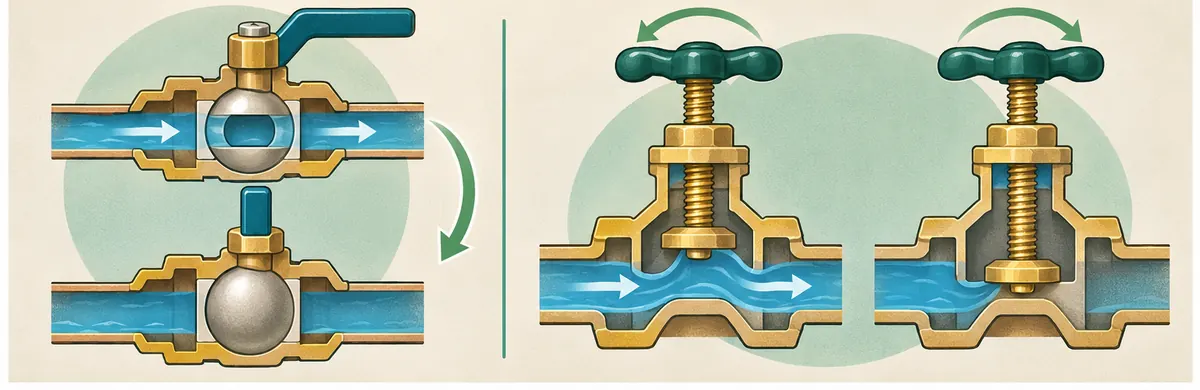
AI-generated explanatory illustration; valve internals are simplified and the image is not a fitting instruction.
Pegler Ballofix: the specification-led compression option
We haven't tested this. Figures are as the maker states them (checked 13 November 2026).
Pegler's Ballofix compression-valve catalogue lists the 15mm 3381ZA as a straight-pattern isolating ball valve with compression ends, screwdriver operation and DZR brass with a commercial chrome finish. The catalogue also shows lever-operated variants.
The useful buying distinction is not the finish; it is how you will operate the valve later. A screwdriver slot is compact and discourages casual movement. A lever is faster and easier to see, but needs swing room and can be knocked.
Primaflow 15mm: a compact budget-style service valve
The Primaflow chrome-plated 15mm valve at Wickes is described as a brass compression valve with quarter-turn screwdriver operation. Wickes publishes a 4 bar operating pressure and WRAS approval number 0912330.
That 4 bar figure is a compatibility limit, not a quality score. Check the system pressure before buying; do not assume every small chrome valve shares the same rating.
JG Speedfit 15SVP: for compatible push-fit pipework
Wickes describes the JG Speedfit 15SVP as a 15mm push-fit service valve for copper, Speedfit PEX and polybutylene pipe. Plastic pipe needs the correct insert. The listing states a 12 bar maximum pressure, suitability for hot and cold water, and says it is not for central heating.
Push-fit saves working room and avoids hot work, but pipe preparation still decides whether the joint seals: use a clean, square, undamaged end and the maker's insertion depth. Do not mix an arbitrary plastic pipe and insert with a fitting merely because both say 15mm.
Quarter turn versus screw-down
A quarter-turn ball valve moves between open and closed in 90 degrees. It is easy to verify: slot or lever in line with the pipe is open; across the pipe is closed. A screw-down valve uses several turns to press a washer onto a seat. It can throttle flow, but the washer and spindle add maintenance points.
For routine local isolation, choose a quarter-turn valve that can be reached and operated. For a main stop valve or another strategic position, use the design and size specified for that service. Gate valves and lever valves covers larger runs.
Do not ignore the bore
Some compact service valves narrow sharply inside. That may be acceptable on a toilet fill or an individual tap, but it can reduce flow on a demanding outlet. If the run feeds several outlets or a high-flow fitting, compare the manufacturer's bore or flow data and consider a full-bore valve.
Buying checklist
- Match the pipe's outside diameter and connection system.
- Check working pressure and temperature, not just nominal size.
- Decide between a discreet screwdriver slot and an accessible lever.
- Leave enough room for a screwdriver, lever travel and future replacement.
- Use DZR material where the water conditions and specification call for it.
- For an outside-tap branch, also read outdoor tap kits and the backflow requirements.
Is a full-bore valve always necessary?
No. It is most useful where restriction matters. A compact reduced-bore service valve can be entirely suitable for one tap or cistern when its rating and flow are adequate.
Can I use the JG Speedfit valve on heating pipework?
Not according to the Wickes listing opened for this guide. It says hot and cold water, but not central heating. Use a valve explicitly rated for the circuit.
Should I force a seized screwdriver slot?
No. Find and test the upstream stopcock first. If the body or joint begins to move or leak, stop and call a plumber.