Guides · Heating
Best thermostatic radiator valves: UK TRV shortlist
A specification-based UK TRV shortlist covering angled, straight, corner and auto-balancing valves, published temperature ranges, lockshields and fit.
Affiliate links: We earn from some links to Wickes through the Awin network. You do not pay more. How this works.
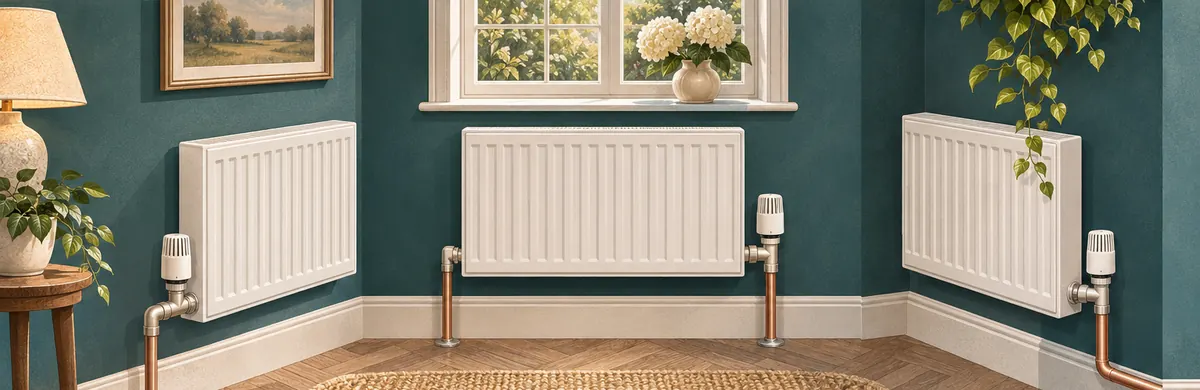
The pipe direction chooses the body before features choose the head. An angled, straight or corner thermostatic radiator valve (TRV) cannot be selected sensibly until you know where the pipe emerges and how it meets the radiator.
This is a research-based shortlist, not a test. It supplements TRV options compared, which explains the existing Wickes listings and their inconsistencies.
Shortlist by installation
| Option | Body and connection | Published control information | Best fit to investigate |
|---|---|---|---|
| Drayton TRV4 auto-balancing | 15mm angled valve and lockshield | 10 to 30°C, settings 1–5 then MAX, frost protection below 8°C | A system being commissioned where automatic flow balancing has value |
| Drayton TRV4 chrome set | 15mm straight valve and lockshield | Wickes states 10 to 27°C and reverse-flow capability | Pipe and radiator connection in line, with a matching lockshield wanted |
| Balterley chrome angled pack | Angled, 1/2in BSP, pack of two | No degree range published on the listing | A compatible Balterley radiator or towel rail only |
| K-Rad white corner set | Corner body for pipework through the wall, 15mm, lockshield included | Six settings; no degree range published | A compatible K-Rad where a wall-exit pipe needs a neat turn |
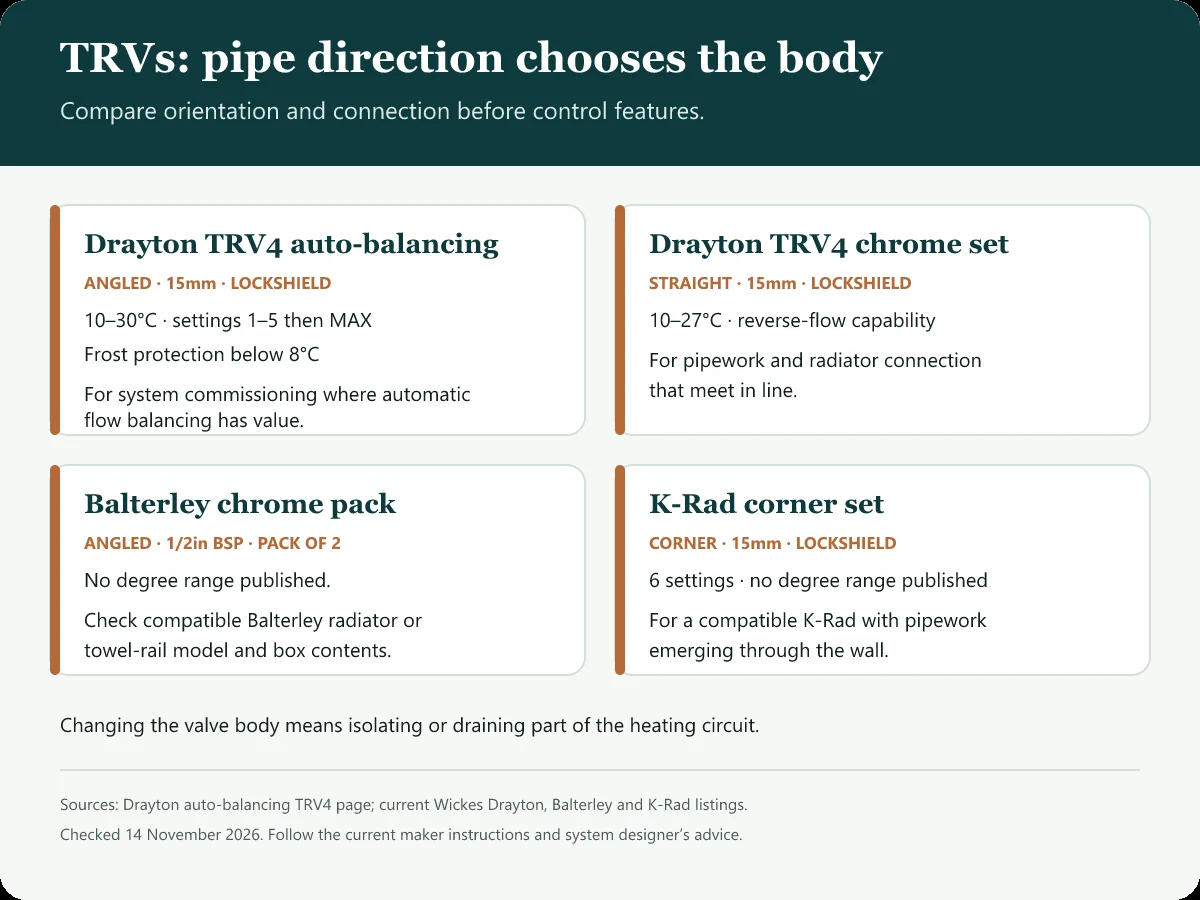
Embed this infographic
<figure>
  <a href="https://leatmere.co.uk/guides/best-thermostatic-radiator-valves/"><img src="https://leatmere.co.uk/assets/images/best-thermostatic-radiator-valves-infographic.webp" alt="Comparison infographic showing body orientation, connection and published control information for four thermostatic radiator valves"></a>
  <figcaption>Infographic: Best thermostatic radiator valves from <a href="https://leatmere.co.uk/guides/best-thermostatic-radiator-valves/">Leatmere</a>.</figcaption>
</figure>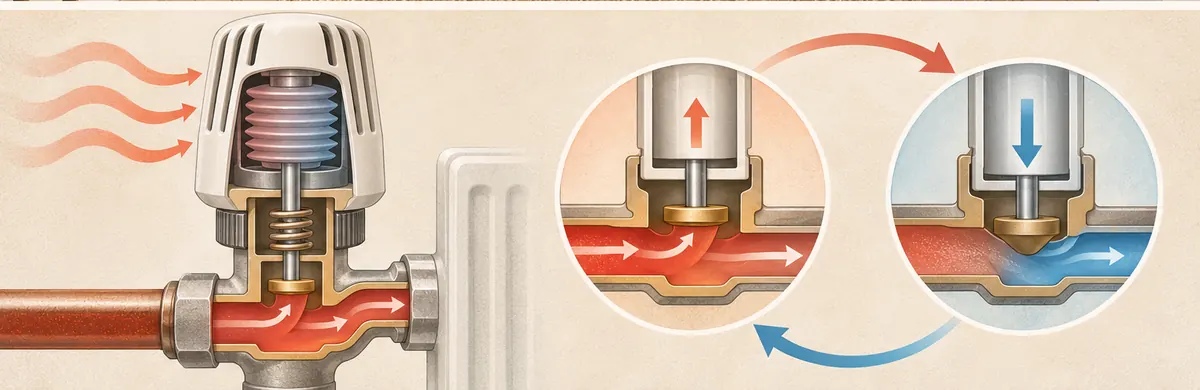
AI-generated simplified explanation of TRV operation; not a fitting drawing or a tested product.
Drayton TRV4 auto-balancing: for a system-level upgrade
We haven't tested this. Figures are as the maker states them (checked 13 November 2026).
Drayton's official auto-balancing TRV4 page identifies a 15mm angled valve and lockshield. It publishes a 10 to 30°C range, settings 1 to 5 then MAX, frost protection below 8°C, a 20-minute response time and EN215 Keymark certification.
Auto-balancing is most relevant when valves across a system are being set up together. It does not remove the need to size radiators, set controls correctly or diagnose sludge and circulation faults. Ask a heating engineer whether the feature suits the whole system before buying one isolated valve.
Drayton TRV4 chrome straight: for in-line pipework
The straight chrome TRV4 set at Wickes includes a 15mm straight body and lockshield. Wickes publishes a 10 to 27°C range, reverse-flow capability and EN215 in the specification.
Buy it for the body orientation and published range, not simply the chrome finish. Straight valves suit pipework that meets the radiator connection in line; they are not a substitute for the common floor-to-side angled arrangement.
Balterley angled pack: confirm the second valve and compatibility
The Balterley angled two-pack at Wickes is listed for Balterley radiators and towel radiators. The page describes two radiator valves but does not publish a temperature range or clearly identify one as a lockshield.
That makes it a compatibility-led purchase, not a general recommendation. Confirm the box contents and radiator model before ordering.
K-Rad corner set: for pipes emerging from the wall
The K-Rad corner TRV and lockshield at Wickes is described for pipework through the wall, with a 15mm connection and six heat settings. The listing limits it to K-Rad radiators and does not translate those settings into degrees.
Corner bodies can give a cleaner wall-exit arrangement, but only where the geometry and brand restriction match.
What the head can and cannot do
A TRV senses the air around its head and restricts water as the room warms. Curtains, a radiator cover or furniture can trap warm air around it and make the valve close early. The numbers are targets, not radiator power levels. Drayton's homeowner temperature table puts TRV4 setting 3 at roughly 19 to 21°C.
Changing a valve body means isolating or draining part of the heating circuit. If you do not know how the sealed system is refilled and checked, use a heating engineer. Do not remove a boiler casing or touch gas components; gas work is for a Gas Safe registered engineer.
Buying checklist
- Photograph the existing valve and pipe direction.
- Check 15mm pipe and the radiator-tail connection rather than assuming.
- Confirm whether a lockshield is included.
- Check whether the product is restricted to one radiator brand.
- Prefer a published temperature range and EN215 information when comparing control performance.
- Plan radiator balancing after valve work.
Is an auto-balancing TRV always better?
No. It is a system commissioning feature. Its value depends on the rest of the heating circuit and how the valves are set up.
Can I put a new head on an old valve body?
Sometimes, but threads and adapters vary. Identify the body and use the maker's compatibility information. Replacing only the head avoids draining; replacing the body does not.
Should every radiator have a TRV?
Not necessarily. The room containing the main wall thermostat may need a different arrangement. Follow the heating designer or controls maker's instructions.