Guides · Toilets
Best toilet fill valves UK: side and bottom entry compared
A UK toilet fill-valve shortlist comparing side-entry, bottom-entry, brass-shank and adjustable plastic-shank options by pressure, height and published features.
Affiliate links: We earn from some links to Wickes through the Awin network. You do not pay more. How this works.
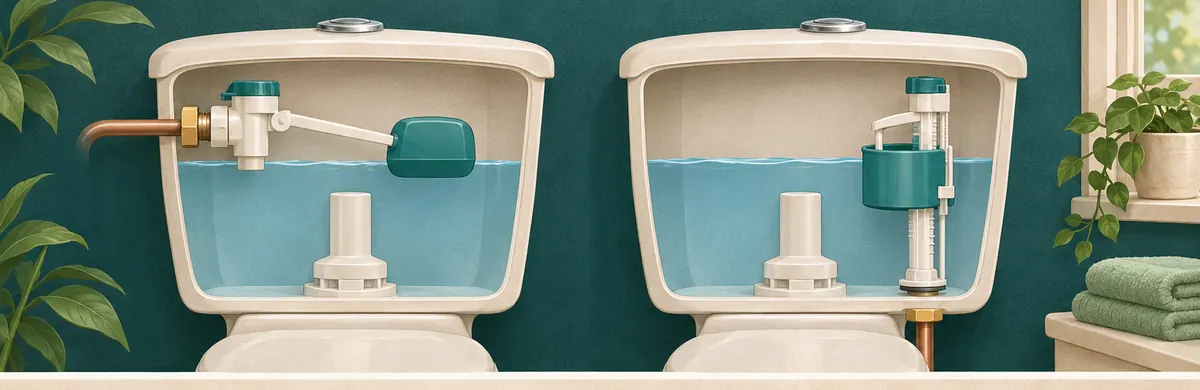
The cistern hole decides the first choice: side entry or bottom entry. After that, match thread, height, pressure range and room around the flush valve. A “universal” fill valve still cannot move the hole in the ceramic.
This guide replaces the proposed waste-and-bottle-trap page because Leatmere already has a complete basin wastes and bottle traps guide. The shortlist below is based on current Fluidmaster and Wickes specifications; we have not tested the valves.
Shortlist at a glance
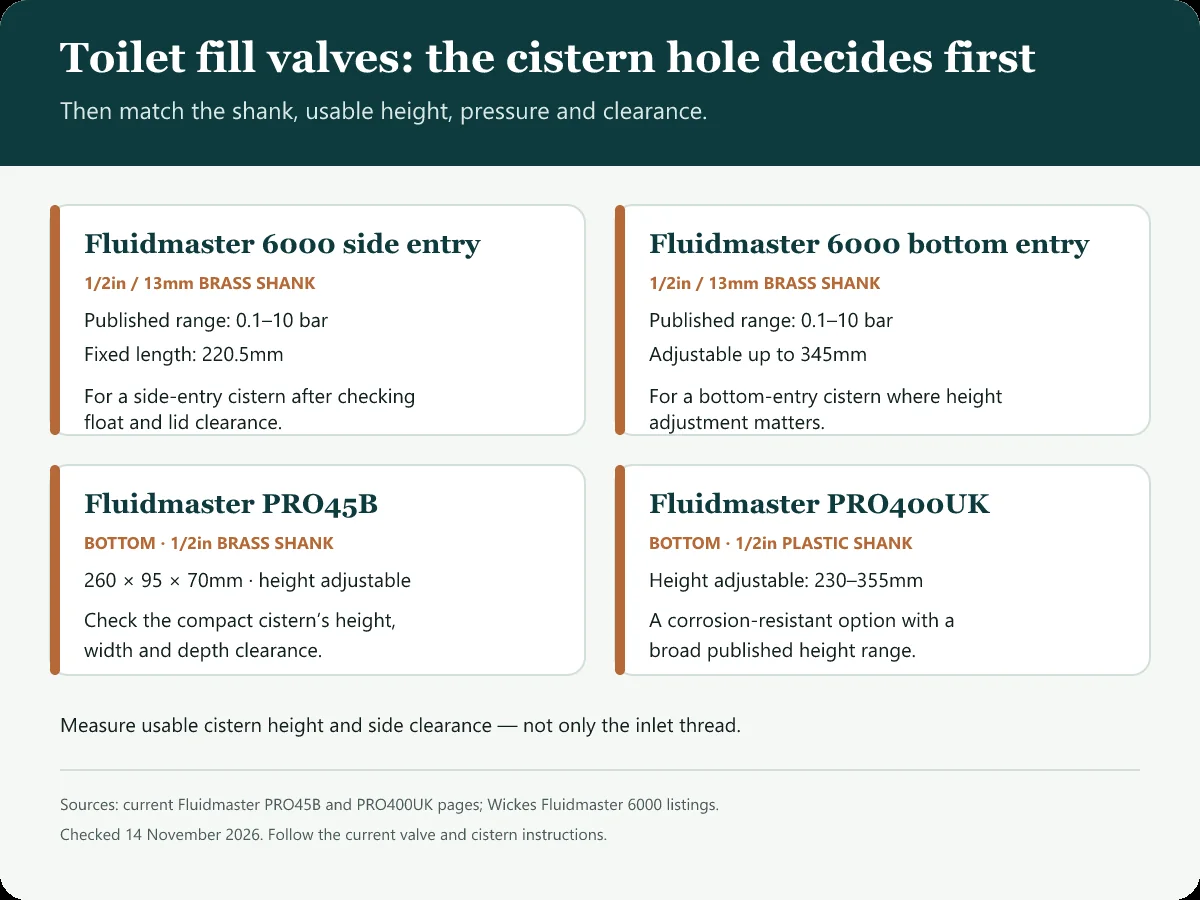
| Valve | Entry and shank | Published range or size | Best fit to investigate |
|---|---|---|---|
| Fluidmaster 6000 Airgap side entry | Side, 1/2in/13mm brass shank | 0.1 to 10 bar; fixed 220.5mm length | A side-entry toilet cistern needing a compact modern replacement |
| Fluidmaster 6000 Airgap bottom entry | Bottom, 1/2in/13mm brass shank | 0.1 to 10 bar; adjustable up to 345mm | A bottom-entry cistern where height adjustment and a brass shank matter |
| Fluidmaster PRO45B | Bottom, 1/2in brass shank | Official dimensions 260 × 95 × 70mm; height adjustable | A professional-grade brass-shank alternative, after checking clearance |
| Fluidmaster PRO400UK | Bottom, 1/2in plastic shank | Height adjustable from 230 to 355mm | A corrosion-resistant plastic-shank option with a broad height range |
Embed this infographic
<figure>
  <a href="https://leatmere.co.uk/guides/best-toilet-fill-valves-uk/"><img src="https://leatmere.co.uk/assets/images/best-toilet-fill-valves-uk-infographic.webp" alt="Comparison infographic showing entry position, shank material, pressure range and dimensions for four toilet fill valves"></a>
  <figcaption>Infographic: Best toilet fill valves UK from <a href="https://leatmere.co.uk/guides/best-toilet-fill-valves-uk/">Leatmere</a>.</figcaption>
</figure>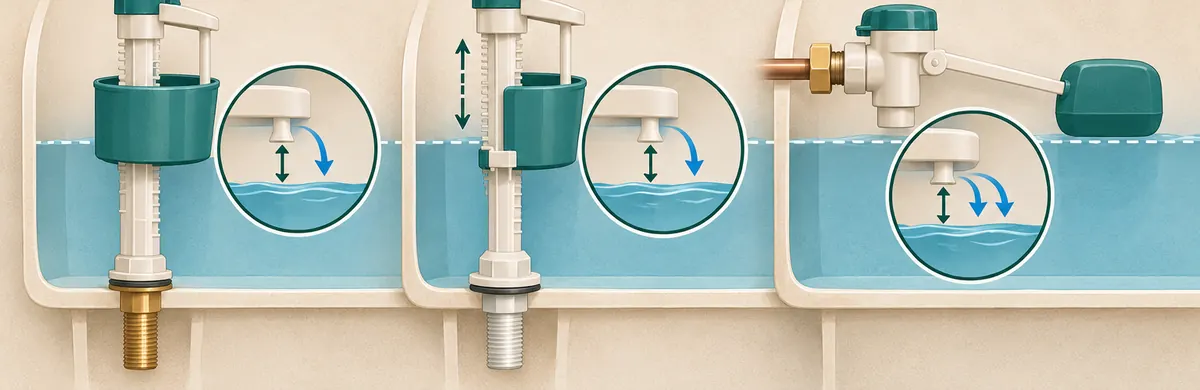
AI-generated explanatory illustration; the internals and air-gap cues are simplified and are not fitting instructions.
Fluidmaster 6000 Airgap side entry: for the upper cistern hole
We haven't tested this. Figures are as the maker states them (checked 13 November 2026).
The side-entry 6000 at Wickes uses a 13mm (1/2in) brass shank. Wickes publishes a 0.1 to 10 bar range, a 220.5mm length, removable filtration, spiral-vortex fill and compliance with BS 1212-4:2016.
Choose this only when the supply enters through the side of the cistern. Check that the float mechanism clears the wall, flush valve and lid, and that the shank reaches the existing connector without straining the pipe.
Fluidmaster 6000 Airgap bottom entry: broad pressure range
The bottom-entry 6000 at Wickes also has a 13mm brass shank and a published 0.1 to 10 bar range. Wickes gives an adjustable maximum height of 345mm and describes integral Airgap technology, removable filtration and a five-year guarantee subject to terms.
It is the direct shortlist choice where the pipe enters through the cistern floor and a brass threaded connection is preferred. Measure from the cistern base to the underside of the lid, not to the top of the pan.
Fluidmaster PRO45B: brass-shank bottom entry
Fluidmaster's official PRO45B page describes a height-adjustable bottom-entry valve with a heavy-duty 1/2in brass shank, anti-siphon design and dimensions of 260mm high, 95mm wide and 70mm deep.
Those dimensions matter in a compact cistern. A robust shank does not help if the float cup fouls the flush valve or the lid.
Fluidmaster PRO400UK: plastic-shank and widely adjustable
The official PRO400UK page specifies a 1/2in plastic shank and adjustment from 230 to 355mm. Fluidmaster describes the material as corrosion resistant.
A plastic shank avoids corrosion and is light, but it can be damaged by cross-threading or excessive tightening. Follow the maker's washer orientation and tightening instruction rather than reaching automatically for a spanner.
Before ordering
- Follow the supply pipe and identify side or bottom entry.
- Measure the threaded connection and usable cistern height.
- Check the working pressure, particularly on a tank-fed supply.
- Check side clearance from the flush valve and push-button mechanism.
- Inspect the old valve's diaphragm first: a seal may be all that is needed.
The broader fill and flush valve guide explains how to distinguish the inlet valve from a siphon or drop valve. If water continuously enters the pan, use why a toilet keeps running to diagnose which part is responsible.
Is bottom entry better than side entry?
No. The cistern design decides. Bottom entry hides the connection more neatly; side entry can be easier to reach. Neither is interchangeable without a suitable hole.
Does a brass shank make the whole valve better?
It makes the threaded connection more resistant to stripping and cracking, but valve fit, pressure range, seals and maintenance access still matter.
Can I replace only the diaphragm?
Often, if the body and float are sound and the maker sells the correct seal. Use the exact part for the valve model; similar-looking diaphragms are not necessarily interchangeable.